

Learn · Taroselia
Reversals: an optional layer, not an alarm
Choose a consistent way to handle reversed cards without treating them as automatic bad news.
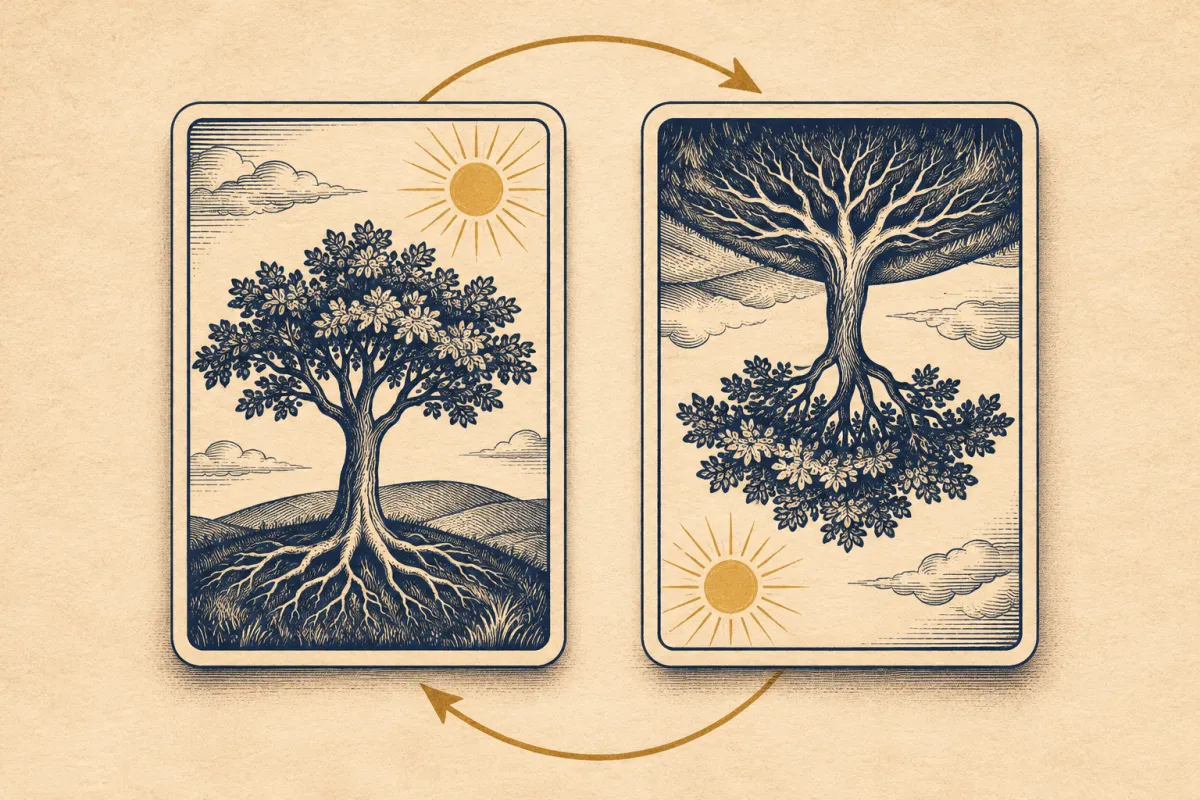
Decide before you draw
A reversed card appears with the top of its picture pointing downwards. This is different from a face-down card, whose picture is hidden, or a card placed sideways as part of a spread. Readers use different conventions for interpreting reversals, and some do not use them at all. Decide on your approach before drawing so that you do not change the rules to suit a result.
In Taroselia, reversed cards are optional. With a physical deck, record the orientation you actually drew when the reading allows reversals. If you prefer upright-only practice, you can explore complexity through the image, the position and the surrounding cards.
Choose one lens at a time
A reversal can be read as a prompt about an inward expression, a difficulty accessing a theme, an excess, or a need to reconsider an approach. These are possible methods, not simultaneous requirements. Pick the lens that is useful for your practice and explain how it connects with the question.
A reversed card is not necessarily the opposite of its upright meaning. A theme of generosity, for example, might raise questions about boundaries or the ability to receive. Neither reading establishes that you or someone else has a fixed character flaw.
Let context limit the interpretation
Read the position prompt and look again at the scene before adding a reversed keyword. If several interpretations seem plausible, write down two and compare them with what you actually know. Do not use orientation to turn uncertainty into a dramatic prediction.
When reversals make a reading harder to understand, simplify your next practice session. It is better to describe one upright card thoughtfully than to feel obliged to manage a system that does not help you reflect.
Tarot is for reflection, not a promise of prediction.