

Learn · Taroselia
The four suits and numbered cards: a practical map
Build a flexible vocabulary for Wands, Cups, Swords and Pentacles, then let each scene add detail.
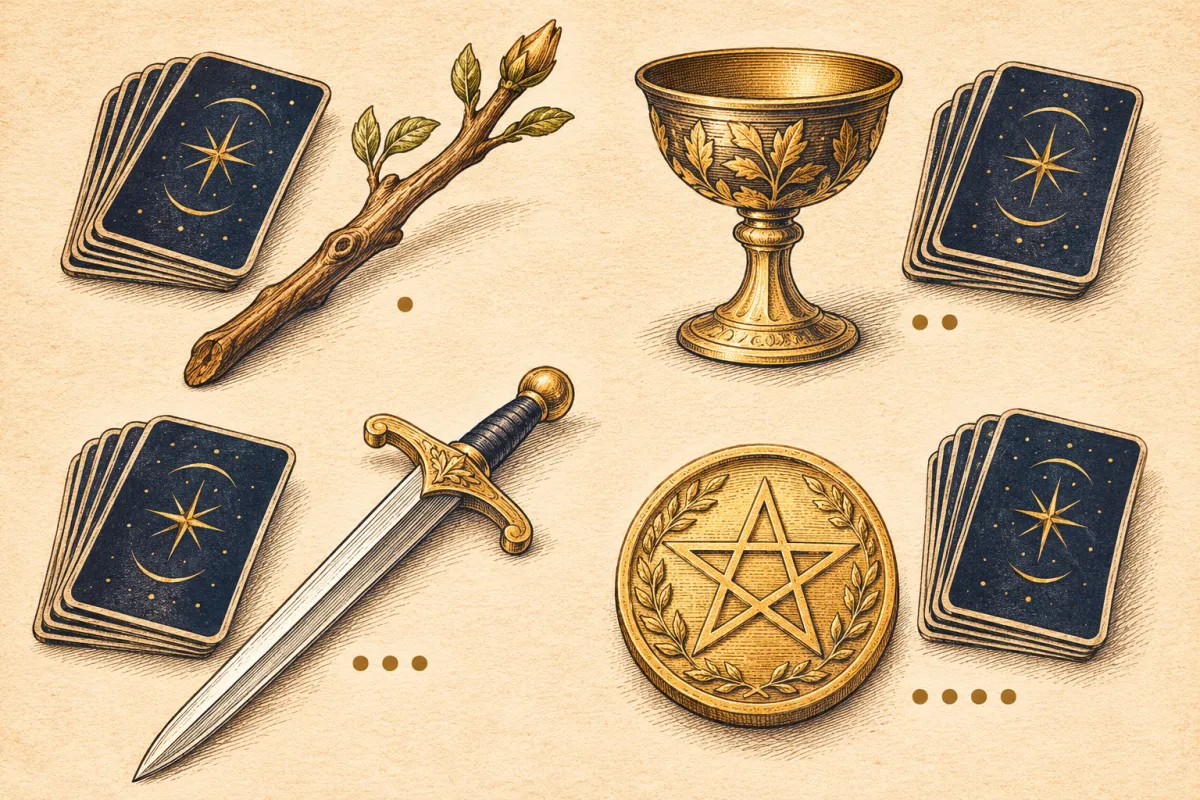
Use suit themes as a first lens
In many contemporary Rider–Waite–Smith reading practices, Wands are associated with initiative and energy, Cups with feeling and connection, Swords with thought and conflict, and Pentacles with practical resources and sustained work. These are interpretive conventions, not scientific categories.
A suit suggests where to begin looking, not where to stop. A Cups card may relate to a work friendship; a Pentacles card may prompt reflection on the time required for a creative project. Let the question and image qualify the suit theme.
Numbers can organize your study
Try comparing all four Aces, then all four Twos, and so on. You may find recurring ideas such as beginnings, exchange, difficulty or consolidation. Treat those patterns as a personal learning framework rather than a mathematical law built into the deck.
Read each scene as well as its number. Two cards with the same number can have very different moods. If a number-based keyword contradicts the image, explore the difference instead of flattening both cards into the same definition.
Read a pattern without overclaiming
A spread containing several cards from one suit can be a prompt to explore that area. It does not prove that another area is absent from your life. Three Swords cards might invite attention to communication, but they do not diagnose a mental state or predict an argument.
Compare the cards’ actions and settings. Is a resource being offered, held, lost, shared or developed? Those verbs often lead to more precise reflection than repeating a suit keyword three times.
Tarot is for reflection, not a promise of prediction.