

Taroselia
Learn
Explore tarot at your own pace, from your first card to a practice you can describe in your own words. Begin with our learning library or find the practical Taroselia guide below.
Ten essential reads for a thoughtful tarot practice
Start with the foundations, then explore imagery, interpretation and the habits that make a practice your own. These ten original guides are written for curious beginners and returning hobbyists.
Jump to the Taroselia guide ↓
Meet the deck: history, structure and a useful starting point
Understand the 78-card deck, where tarot comes from, and why a reading can be a practice of reflection.
Read article
Look first: how to read the picture on a card
Learn to separate what you can see, what you associate with it, and what you might infer.
Read article
The Major Arcana: big themes without a fixed destiny
Approach the Major Arcana as a vocabulary for transitions, values and patterns rather than inevitable events.
Read article
The four suits and numbered cards: a practical map
Build a flexible vocabulary for Wands, Cups, Swords and Pentacles, then let each scene add detail.
Read article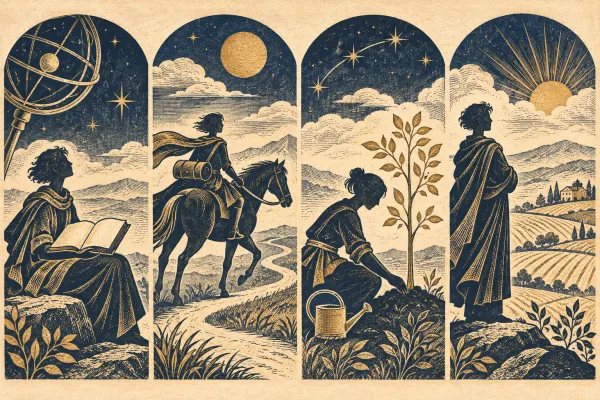
Court cards: roles and approaches, not fixed identities
Read Pages, Knights, Queens and Kings without reducing people to age, gender or personality stereotypes.
Read article
Ask better questions: trade prediction for perspective
Turn vague or closed questions into prompts that support attention, agency and practical follow-through.
Read article
Choose a spread that serves the question
Understand how position meanings guide a reading, from one card to a larger layout.
Read article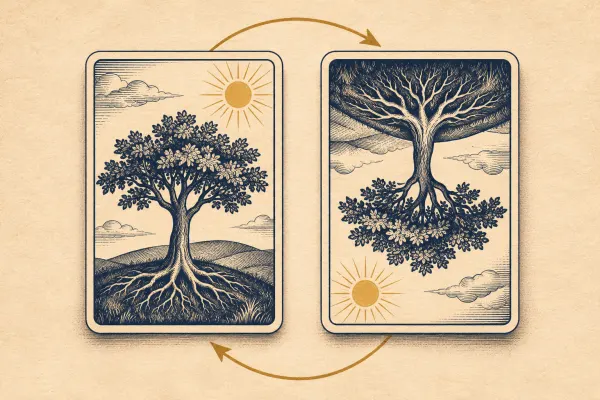
Reversals: an optional layer, not an alarm
Choose a consistent way to handle reversed cards without treating them as automatic bad news.
Read article
Keep a tarot journal you can learn from
Record observations, uncertainties and follow-up without rewriting the past to make a reading seem correct.
Read article
A grounded practice: intuition, boundaries and reading for others
Make space for intuition while keeping consent, uncertainty and everyday evidence in view.
Read article
Start with a question—or leave it blank
Questions and topics are optional. You might ask what deserves your attention or what choices you can influence. Avoid adding names or details you do not need for reflection.
Choose a spread
Begin with One Card for a single focus, try a preset spread, or create a custom layout with 1–12 positions. Each position gives a prompt for the card placed there.
Choose how to draw
- Random: let Taroselia shuffle and deal cards, then reveal them in order.
- Intuitive: choose face-down positions from the deck before revealing your selected cards.
- Physical: enter the cards from your own deck, position by position. You can correct the entered cards before saving.
Decide whether to use reversals
A reversed card is upside down. Turn reversals on before you begin if you want them. A sideways card in a spread is part of the layout, not automatically a reversal.
Keep an unfinished reading
An unfinished reading stays temporarily in this browser tab for up to two hours. It is not a saved journal entry. Language changes can preserve it; closing the tab or clearing browser storage can remove it. Creating an account does not save it automatically. Choose Save when you want to keep a completed reading.
Keep readings and notes privately
Sign in to save a completed reading and add notes. Saved readings and notes are available inside your account. Account settings let you export or delete your data.
Choose AI only when you want it
AI requires a verified account and an explicit request. Two successful AI responses are included each UTC calendar month; initial interpretations and follow-ups share that allowance. Each successful follow-up uses one response too. After that allowance is used, additional successful responses need eligible purchased credits. New credit-pack purchases are offered only when checkout is enabled. Failed responses do not consume an entitlement.
Leave room for your own judgment
Tarot and AI can be mistaken or unhelpful. They cannot promise a prediction or decide for you. For medical, legal or financial concerns, seek qualified professional support. You can stop a reading or skip AI at any time.
Explore at your own pace
Tarot is for reflection, not a promise of prediction.